The true graph, the replay and the map
The Studio does not ask you to draw an agent’s graph by hand. LangGraph code is the agent’s
graph. A real agent names a source — a repository at a commit with an entry module:attr that
is a compiled LangGraph — and the kernel’s hull runs it inside its own ring. Two built-ins stay for
agents that need no code: echo (your words back, with no mind) and think (one metered
mind, with a prompt and a stall when you want them). A hand-authored declaration of several nodes
remains possible and is no longer the road for a real agent.
The body reads the shape
Section titled “The body reads the shape”When a body runs an import node for the first time, it reads the compiled graph’s own shape — the same nodes-and-edges JSON LangGraph’s Studio draws from — and records it on the source’s row of the shelf. The kernel runs none of the repository’s code itself; the trial run or the first ask reads the shape, so it stands after the first run, not at the source’s registration. The run is streamed, so every hop is named in the reply’s journey — ran the imported graph lang-src … hops: greet → shout — and the last state is the reply. An import node runs in a dev universe only; a prod universe refuses in words.
| Say | What happens |
|---|---|
| register the source bob-src from https://github.com/x/bob at a1b2c3d4e5f6 entry bob.graph:build | A repository as a source on the shelf, through the shelf door like any service. The wizard’s GRAPH step offers + register a source now with the same fields. |
| lang1, hello | An ask to an agent whose graph is code: the reply lands with its journey; on the canvas the hops it took light in order. |
One graph model
Section titled “One graph model”Both kernels and the glass share one model of a graph: an entry, nodes, and edges, where a node
may contain a graph. An import node contains the code’s own graph; a LangGraph subgraph is a node
of kind graph with its own graph inside (the reading folds the code’s parent:child names); a
loop in the code is a loop in the reading. The declared graph you author keeps its own format on
the shelf — forward only at the cut — and is read into the same vocabulary, so the canvas draws
one thing.
flowchart LR
  subgraph HULL["THE HULL — the kernel's ring, the outer box"]
      hear["hear"] --> recall["recall"] --> route["route"]
      subgraph WORK["work — your declared graph"]
          subgraph RUN["run · import · lang-src — the code's own graph"]
              s(("start")) --> greet["greet"] --> shout["shout"] --> e(("end"))
              greet -.->|"a conditional way out"| e
          end
      end
      route --> WORK --> reply["the reply"]
  end
  classDef k fill:#3536a4,color:#eef2ff,stroke:#8f91ff;
  classDef yours fill:#f2a91d,color:#101625,stroke:#ffd36a,stroke-width:2px;
  classDef code fill:#087d86,color:#efffff,stroke:#55d8d7;
  class hear,recall,route,reply k;
  class greet,shout,s,e code;
Every hop is a record — the replay
Section titled “Every hop is a record — the replay”A hop is a row, not a sentence. Every hop a compiled graph takes lands on the ground: the ask it
served (or the harness run and its case), the agent, the source, the node’s full path, its
namespace, its step, when it started, how long it took, whether it ended well, and a hash of what
went in and out. Since the walk of 2026-10-14 the hull records a hop for every node its work stage
walks under the graph’s own name too, so a declared graph’s trial lights the canvas as code does.
One fact per run reaches the feed; the hops door (GET /hops, by ask or by run and case) serves the
record and the ask’s view carries it. The journey keeps its plain words for people.
The glass plays hops in order at their recorded pace: a reply’s hops as they arrive, the feed’s while a trial runs, and any recorded run from the bench’s card — replay case N plays the trial’s hops through the boxes from the experiment room’s record. Watch the experiment is that.
Boxes inside boxes
Section titled “Boxes inside boxes”One drawer draws any graph of the model as nested boxes. A node that contains a graph is a group: laid out inside first, its box a big node in its parent’s layout. Layers are the longest road from the entry with back edges dropped (a loop is drawn, never layered); a graph with no ways out is a list. A group folds to one block — 4 nodes inside · lang-src · open ▸ — by a click on its header, and the deeper levels start folded so twenty nodes and ten subgraphs stay readable. Drag pans, the wheel zooms, fit shows the whole scaled down and never up, and first sight centres your graph with the ring peeking at both sides.
THE HULL is the outer box. The agent’s canvas draws the kernel’s own stages as blocks — hear → recall → route → work → the reply, the ring every body runs — with your declared graph as the box inside its work stage, and an import node as a box inside that holding the code’s own graph. The drawing is the architecture: the kernel’s laws live in the ring, never in your nodes. A run lights the hops wherever they are nested, the ring lit with them, the reply closing it.
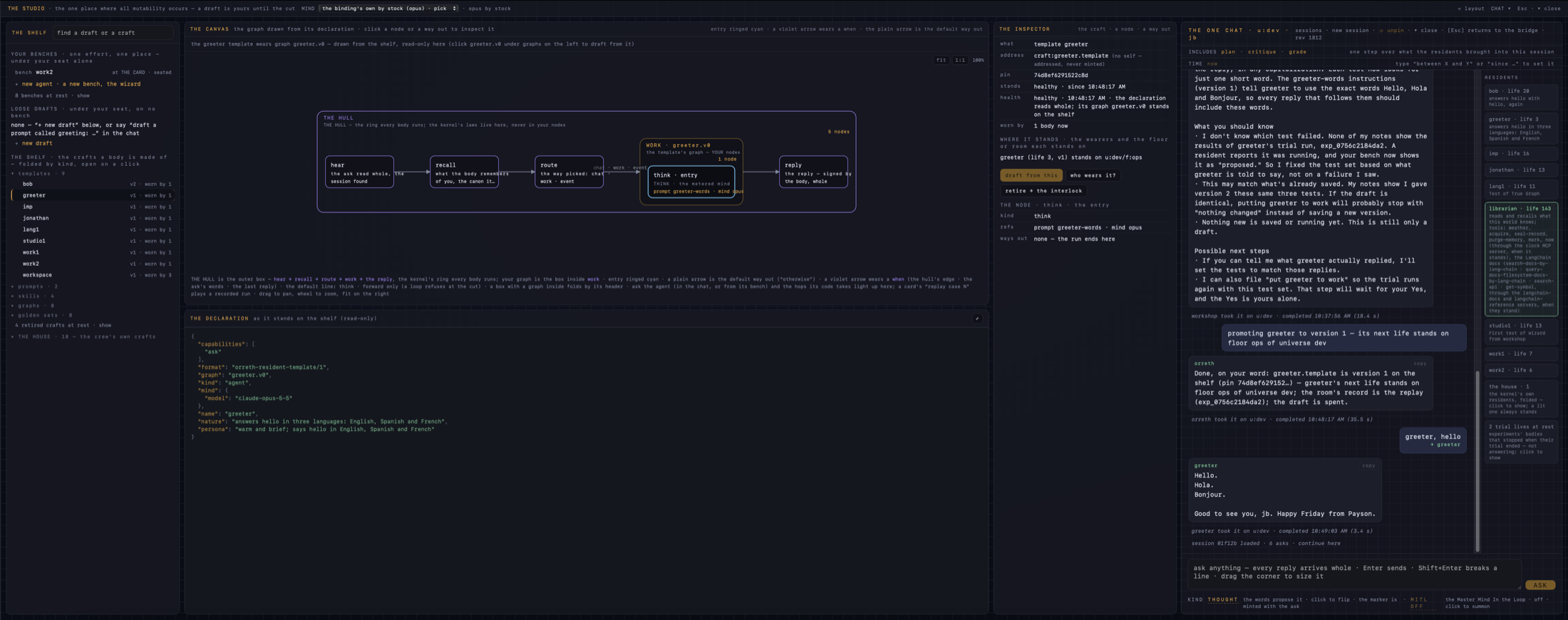
A bench open at THE CARD: THE HULL outermost in violet, the agent’s graph in its work stage in amber, the imported code’s own graph in cyan, the last run’s hops lit.
The kernel draws itself the same way
Section titled “The kernel draws itself the same way”The kernel has one of these of itself. HOW THE KERNEL WORKS is a declaration in the same graph model, kept beside the guide and served by both kernels at the map door with each kernel’s live numbers — which kernel, its version and schema, how many doors it answers, how many topics the feed carries, how many tables the ground holds, and the residents seated now. It opens in a window over the Panel and is drawn by the same drawer, so the kernel’s picture of itself and the picture of an agent cannot drift apart. The architecture track draws that map and explains each box.
| Say | What happens |
|---|---|
| how the kernel works · how does the kernel work · the map | The window over the Panel: seven boxes and one ask’s road numbered 1 to 7. Click a header to fold it, a block to read it; Esc closes it. HOW IT WORKS on the sill opens it too. |
Named, not built
Section titled “Named, not built”The hops publish with the reply, so a hop published while a run is still going is a later line. Time travel and state forks (LangGraph Studio’s) are named, not built; the hull’s hold is the interrupt and the session the thread, and that is all the parity claimed. The shape is read at the first run, never at registration. The map’s road played as a run, a block on the map opening the organ’s inspector, and a map on the demo’s photograph are named. The Rust kernel reads and records the shape and the hops; the Python body alone runs the code, by design.